¶ Troubleshooting for Beginners
Did something go wrong with one of your first cheeses? It's okay, something always goes wrong. That's normal, so don't panic.
¶ Is My MIlk Bad?
You always want to start with good, fresh milk, the best quality you can find. If your milk is old, already curdled, growing mold on top, or smells “off” or “bad”, throw it out. Do not make cheese with bad milk, that will not rescue it. Any of those symptoms generally mean the milk already has bacteria and potential pathogens growing in it, and it's not worth the risk.
This is a relatively easy one to evaluate: always check your milk before using it for cheese making, and if it looks or smells off in any way, get fresh milk that is in better shape instead.
¶ Curds Didn't Form
Curds will refuse to form on occasion. If this happens, it's quite possible there's nothing wrong with just drinking the milk, but if in doubt, throw it out or give it to your livestock if you have any, or pour it out in the garden because it makes a great garden soil amendment. It may be one of the following:
- The milk was UHT pasteurized. Shelf-stable milk is unsuitable for making cheese, and will not form a curd.
- The dairy animal had mastitis (an udder infection). This can change the milk in ways that make it hard to form a curd. If it was pasteurized, you can probably drink it just fine as long as it had been properly refrigerated, but there's no harm in throwing it out, either.
- The milk needed additional calcium added (calcium chloride), and would have formed a curd with that extra bit of help. This happens with regular pasteurized milk, but can also happen with raw milk in very early or late lactation.
¶ Blowing Defects
There are two blowing defects: early and late blowing. Luckily, they manifest different symptoms and at different times, so they are reasonably easy to tell them apart.
¶ Early Blowing
Early blowing happens generally within the first 24 hours, usually in the cheese vat or while the cheese is in the press. The curds will be foamy, frothy, and feel like they're full of air, because they're loaded with CO2 or holes from CO2 production. If the curds are like this and are floating in the cheese vat, or the cheese feels like a squishy sponge in the press, it is almost certainly early blown.
This is almost always caused by one of two culprits: runaway yeast cultures, or coliforms (of which E. coli is the most famous). It's almost impossible to tell which of the two caused it, so if this happens, throw the cheese out. Check your cleanliness procedures and make sure you're avoiding any way for contaminants to get in. If you are certain everything in your process is clean, then it could be coliform contamination of the milk itself at collection, so the dairy step needs to be scrutinized for cleanliness.
¶ Late Blowing
Late blowing usually shows up sometime between week 2 and week 6, often around week 3, where an aging cheese wheel will begin to swell and bow out.
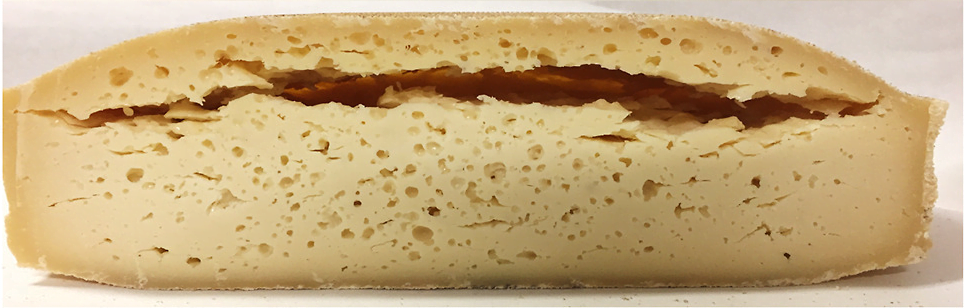
Late blowing is characterized by having many gas holes, usually irregular and not very shiny surfaces in the holes, and horizontal fissures sometimes show up. Here are the questions to ask yourself to know if it's late blown, and if it's actually bad:
- Are there many holes, when you didn't expect there to be? If you didn't add gas-producing cultures like propioni shermanii, then significant holes are not expected.
- Are the holes round in shape, and shiny inside? This is probably produced by propionic bacteria, which are not bad (they make swiss-style cheese holes). If the holes are instead irregular and not shiny, this is not a good sign.
- Are there horizontal fissures? Desirable gas producing cultures don't tend to do this, so it's not a good sign.
- Does the cheese smell of sulfur or of butyric acid (essentially, vomit smell)? This is a sure sign it is blown.
The usual culprits of late blowing are the clostridia family of bacteria (of which botulism is a member). Forntunately, botulism is pretty much never the cause of late blowing in cheese, but it is instead caused by C. butyrica and C. tyrobutyrica, hence the vomit smell. While it's not pleasant to eat, generally if you accidentally took a bite of the cheese it would not likely harm you, and in fact may be possibly slightly probiotic, but it isn't a particularly pleasant experience.
¶ Sour Taste
¶ Crumbly Cheese
¶ Mold Growth
¶ Temperature Problems
If your milk is going directly into the vat and is made into cheese, you don't have to refrigerate it. Otherwise, ensure the milk is refrigerated ASAP after collection, and stays that way until you are heating it for cheese making. Ideally the milk should get to fridge temperature (33-40 F) within a couple of hours of collection. Ideally the milk should get heated to ripening temperature within an hour or two as well once you start heating it.
After your cheese is pressed and has hit your target acidity, it should be cooled to cave temperature for salting as quickly as possible; either the salt brine should be cold, or the cheese wheel should be cooled quickly and then dry-salted.
Keep your cheese wheel at cave temperatures (50-60 F, ideally 50-55 F) during aging, except for specific cheese styles that have a “warm” period that is controlled.
Get an accurate thermometer for the vat, and a good one to track the air temperature in your cave / aging space, and use them.
¶ I Got Sick
Make sure your milk is collected cleanly. Make sure if the milk isn't going directly into the cheese vat that it gets refrigerated ASAP after collection. Make sure your cheese making vat, utensils, molds/forms, hands and so on are clean and sanitized where possible. Make sure pets don't have access to the cheese making area. Make sure any water you use in the process of cheese making is clean, and any water going into the cheese (in e.g. washed curds) is non-chlorinated. Make sure any salt you are using is non-iodized. Make sure your cultures are as fresh as possible and are not contaminated. Make sure the dairy animals aren't sick or have mastitis, and that they are being well taken care of.
Double check that your milk is cleanly collected, and that your cheese making space is clean and sanitized. It's usually one of these two items that causes a problem.