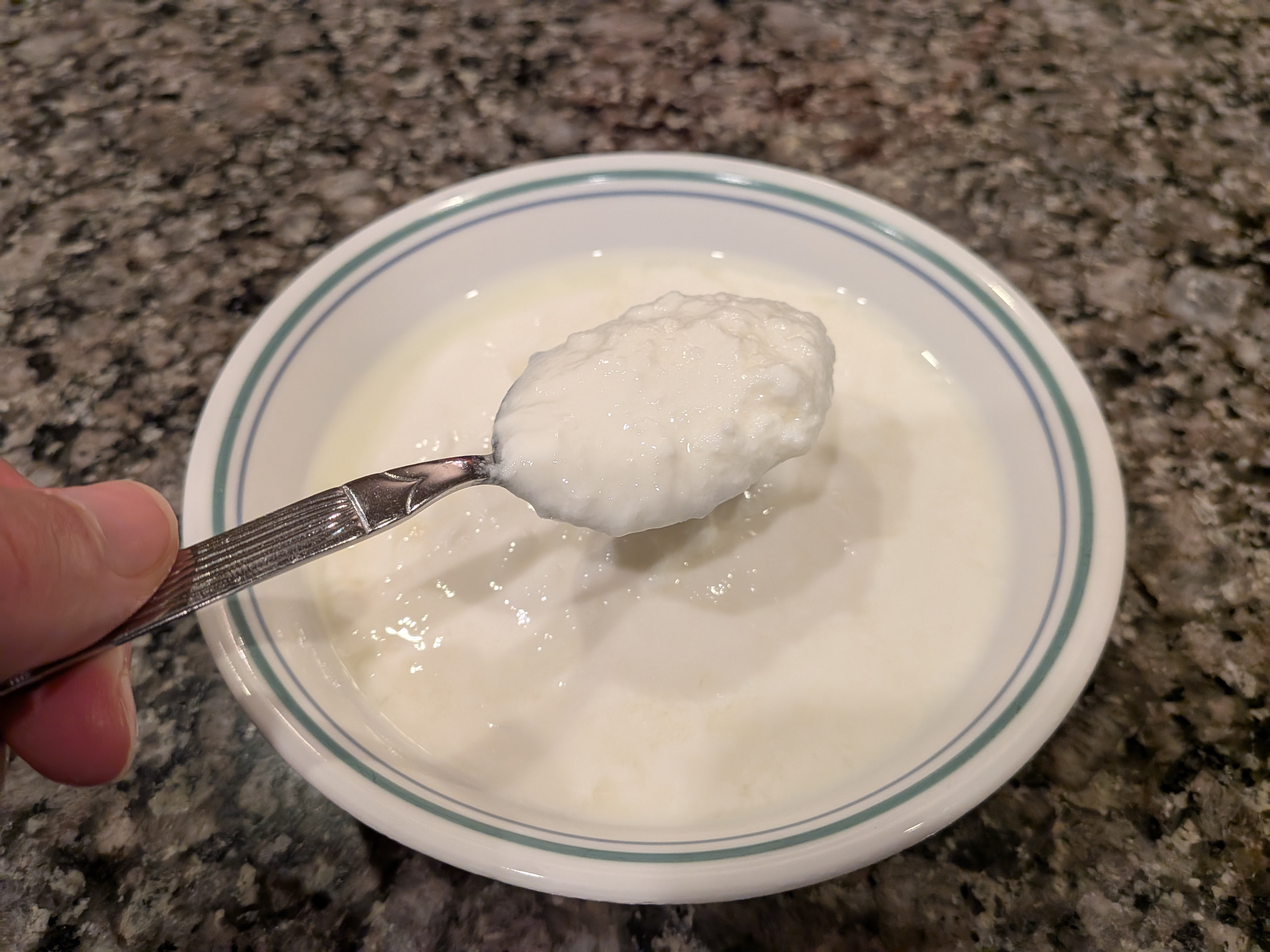
¶ What is Clabber?
A dairy animal's milk as it is comes out will naturally have bacterial cultures in it, even if just a small amount. The teat canal will harbor these bacteria, although generally there won't be much if any bacteria further up into the udder. Raw milk, then, will have endemic cultures. What kind? Generally they are of the LAB (lactic-acid bacteria) sort, usually both mesophilic and thermophilic types. The particular strains of bacteria are local to the area, and maybe even the particular dairy farm.
If these bacteria are allowed to go to work on the milk for a period of time, they will multiply and produce lactic acid, eventually curdling the milk into a loose yogurt consistency. Once this occurs, the milk has turned into clabber. It's also a verb: the milk has clabbered.
Not all clabbered milk is to be desired, however; if the dairy animal has mastitis, or if the teat canal contained bacteria that is less desirable due to uncleanliness, such as coliforms or clostridia, the resulting clabber may never form at all, or it may be overly separated, chunky, have an off smell, and so on. Clabber contaminated with bad bacteria could make you sick, so pay attention to what good clabber is like. Proper clabber has a pleasant cheesy and/or yogurty smell to it, and if you look at the curd it shouldn't have the appearance of having many gas bubbles, but instead look quite smooth and homogeneous. At least until you shake or stir it, it will be smooth, but it should break into fragile and loose curds once you do.
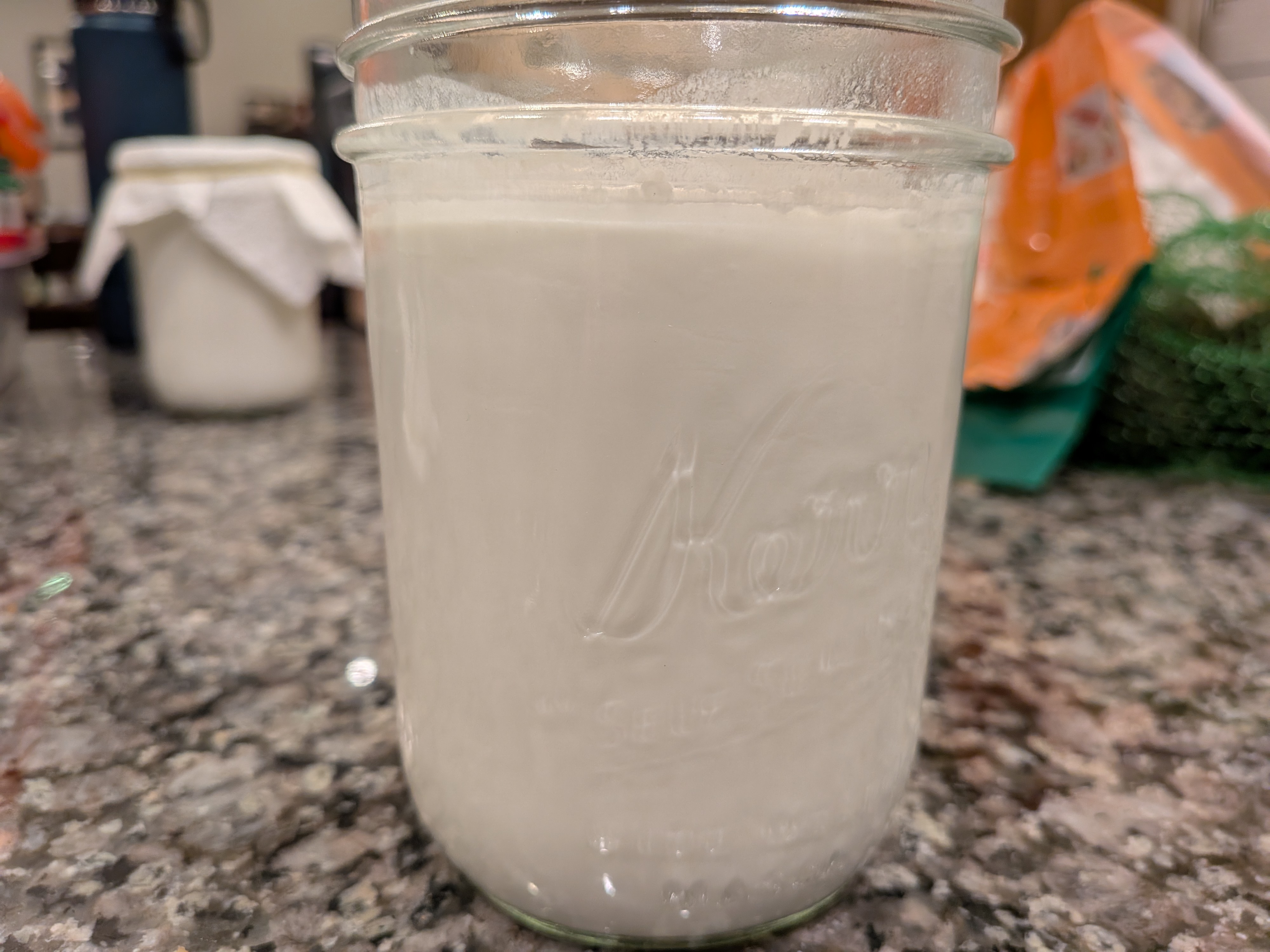
¶ Clabbering Milk
Depending on which type of clabber you desire, thermophilic or mesophilic, to make clabber is quite simple. Using a clean and sanitized jar, place your raw milk into the jar and cover it so nothing can get in. It doesn't need to be sealed tightly, but you should ensure that no contaminants can float in. For mesophilic clabber, leave it out at room temperature, around 70 F or 21 C while the endemic cultures slowly multiply and begin to acidify the milk. For thermophilic clabber, it should be incubated at about 110 F / 43 C until the milk reaches that temperature for at least an hour or two, which will kill any mesophilic cultures and leave the thermophilic cultures intact. After that, it can sit at room temperature to continue clabbering. Typically, thermophilic clabbers will thicken faster than mesophilic clabbers.
¶ Strengthening
The first round, with unclabbered raw milk, may take between 2-5 days or so to finally clabber and form a curd. Milk that is very cleanly collected will have low bacterial counts and will take closer to 5 days. Milk that is less cleanly collected may take a shorter amount of time, but is more likely to have contaminating bacteria that is undesirable and should be carefully evaluated for safety and palatability.
Once the first successful clabbering has occurred, empty the jar of most of the clabber except for a couple of tablespoons or so (you're shooting to have at least 3% by weight of the next jar of milk be the previous clabber), and re-fill with milk. You can use raw milk again or you can use pasteurized milk. If you are making a thermophilic clabber, incubate it at 110 F / 43 C until it reaches that temperature for an hour or two before putting it back out at room temperature, especially if you used raw milk, so you isolate the thermophilic cultures. In both cases, then let it clabber again. This second time it should go faster.
You should probably repeat this process one more time. These repetitions are strengthening the culture, and ensuring a very high population count of beneficial LAB. It should clabber in as few as 12 hours for a mesophilic clabber, and 6 hours for a thermophilic clabber. They should smell quite good; the mesophilic clabber should smell like fresh cheese curds, and the thermophilic clabber should smell like yogurt and a little bit of cheese. At this point, you should have a safe, effective, and delicious clabber for eating, for culturing batches of cheese or yogurt, and so on.
¶ Feeding
You can maintain a clabber culture almost indefinitely by just feeding it again, keeping a few tablespoons of clabber in a fresh jar of milk, over and over. It is very analogous to keeping a sourdough starter, or kefir grains, feeding it regularly to keep it strong. You can put it in the fridge for a while, around a week, but you should probably feed it at least once a week to keep the cultures strong. Keeping it in the fridge frequently may alter the balance of cultures, however, so if you wish to use it for cheese you may want to feed it multiple times outside of the fridge to help it regain strength and be ready for action.
¶ Using Clabber
Clabber is quite similar in its use for fresh eating as you would use kefir or yogurt. Mix it into smoothies, eat as a (loose) yogurt, cook with it as it has a nice acidity to it, and so on.
Clabber should, in theory, freeze well to be used later. If you have an abundance of milk, it isn't difficult to make more clabber later as well if you plan ahead by about a week.
¶ Culturing Cheese and Yogurt
It is perhaps even more powerfully used as a mother culture for making yogurt (with thermophilic clabber) or cheese (both types, depending on your goals for a given cheese). You will not know exactly what strains of LAB are in it, so it will take some experimentation to get a feel for what kind of cheese it makes well. Given that cheese will amplify any benefits of a culture, as well as any drawbacks or contaminants, during your first few times using your clabber as the culture for cheese you should pay careful attention to how fast it acidifies your curds, any contamination problems such as early or late blowing, and so on. Any issues will indicate most likely a cleanliness problem with how the milk is collected, or how healthy your dairy animals are. Once you have established that it is a good culture for cheese making, you can make various cheeses and tune your use of your clabber.
Take the volume of milk for your cheese and calculate what 2-3% of that volume is; that should be approximately how much clabber you use to culture your cheese or yogurt. If you are using raw milk, you can likely use the lower end of that, but for pasteurized milk you would want to use at least 3%. Because clabber is an active culture, it doesn't need a “wake up” period like DVI/freeze-dried cultures do. For making cheese, you may be able to mix it into your milk and then proceed directly to adding rennet. If you are concerned about this, measure the milk pH before adding your clabber culture and then afterwards, and wait for a 0.1 pH drop (which may be almost right away), and then proceed to rennetting.
When making cheese, note that clabber may not have everything you need, so for specific types of cheese you may want to add some other cultures specifically for the cheese style. This may include specific LAB, propionic acid bacteria, but especially it will not have surface ripening cultures such as penicillins and geotrichum. If you add other LAB strains directly, you should dial back your amount of clabber so as not to acidify your cheese curds too quickly.
A final note about clabber and cheese is that you can just use the clabber itself as a cheese curd, and drain it in cheese cloth to remove the whey until you get to a consistency that you like. Mix in some salt to taste and to encourage a little more whey drainage, and the resulting clabber cheese will likely be similar to greek yogurt or even a cream cheese if it thickened enough. If you add a drop or so of rennet to a batch of clabber, the final drained consistency will be more similar to cream cheese.