¶ Dairy Milk Components
Dairy milk generally comes from about 5 particular types of ruminants: cows (bovines), ewes (ovines/sheep), goats (caprines), camels and buffalo. Each species has different amounts of the various components of milk, tailored for the needs of their young. All mammalian milk contains the same basic components and properties, however:
- Water
- Protein, primarily as whey and casein protein, with smaller amounts of globulins and albumins and a few others
- Fat (collectively called milk fat or butterfat)
- Sugars, mostly lactose
- Minerals, such as forms of calcium, phosphorus, and potassium
- Enzymes
- Antibodies
- And other trace components
When most cheese styles are made, the casein protein and butterfat comprise the majority of the result. The primary acidification cultures feed on the lactose and turn it into lactic acid, lowering the pH of the milk, while usually rennet is used to tie the micelles in the milk together for form into a matrix we call curds.
¶ Micelles
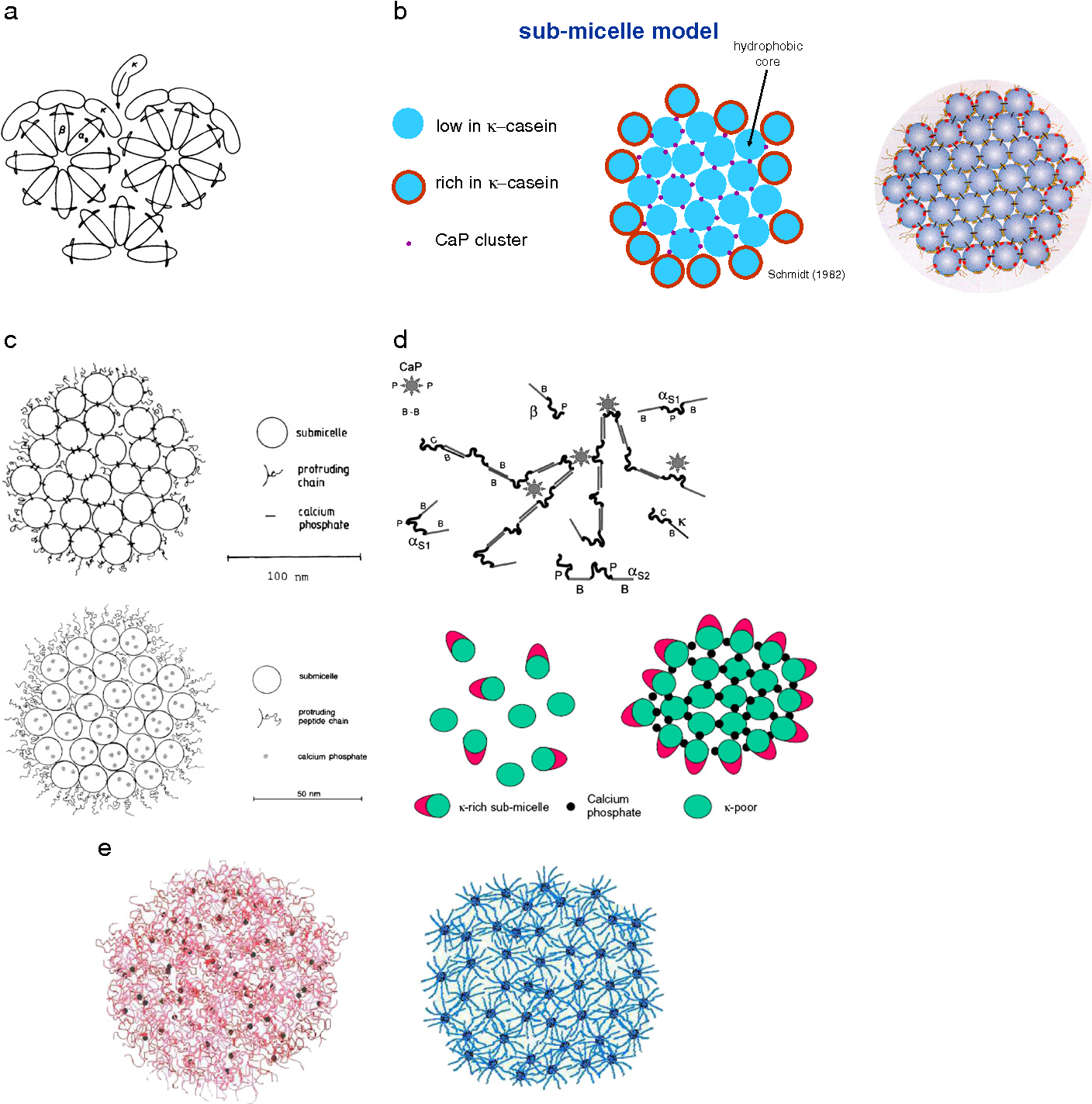
The casein proteins in cheese are bound up in milk into spherical structures called micelles which have a kappa-casein protein layer on the outside, and have other casein proteins on the inside bound together with calcium phosphate. On the surface of the micelles are charged structures that repel those same structures on other micelles, keeping the micelles spread apart and suspended in the milk. For this reason, milk appears to be a liquid and the amount of solids in it are not readily apparent. Part of the magic of getting curds out of milk when making cheese is this transformation where the solids form up into a matrix and suddenly become obvious.
The process of removing the charged structures and linking the micelles together via calcium ions is the job of rennet. Milk can also be coagulated to form a weaker curd by using heat and added acid, which changes the isoelectric point of the milk so that the micelles cannot repel each other anymore and begin to stick together despite the charged structures. This is how cheese such as Paneer and Ricotta are made.
¶ Proteins
Milk protein is primarily composed of whey protein (the sought-after protein used in many protein bars, drinks and powders), and casein protein. Casein protein itself comes in three variants: alpha, beta and kappa casein. Beta casein protein itself has two variants, A1 or A2, which has a single amino acid difference between them. Only cows, and a subset of them at that, produce A1 beta casein protein.
Many human beings are not able to properly digest A1 beta casein protein; it gives them intestinal symptoms that appear nearly identical to lactose intolerance. Historically, most cow milk was A2, but with the advent of huge CAFO dairies (concentrated feeding operations) primarily housing high-producing Holstein cows which have the A1 gene, A1 milk has become almost ubiquitous at the grocery store. Many people who think they have a lactose intolerance may be able to switch to A2 milk produced by other breeds with older genetics such as Jersey and Guernsey cows and tolerate it quite well.
Whey protein is suspended in the milk, so during cheese making as the whey separates, the whey protein largely stays in the whey and is not bound up in the casein-rich cheese. Whey protein can be captured by heating and acidifying the whey further, as in ricotta and paneer cheeses. The whey can also be dried and the leftover solids are rich in whey protein.
¶ Fat
Most of the fat in milk is tied up into triglycerides (about 95% of it), and bound up into fat globules which have a membrane around them similar to a cell membrane. When cream is churned into butter or other agitation happens to milk or cheese in a vat, the membranes are broken and the butterfat is released.
A large percentage of the fat in mammalian milk is saturated fat, particularly medium-chain fatty acids. The saturated fat that is extracted when cream is churned into butter is what makes butter stay solid and typical room temperatures. All milk fats can be deliberately retained or deliberately removed when making cheese depending on the style, so the fat percentage and composition of cheese varies considerably.
Cow milk fat, for example, consists of approximately:
- 64% saturated fat (SFA)
- 26% mono-unsaturated fat (MUFA)
- 3% poly-unsaturated fat (PUFA)
- The rest other forms, such as cholesterol and phospholipids
Mammalian milk is generally rich in conjugated lineoleic acid (CLA), with its corresponding health benefits.
¶ Sugars
The primary sugar in milk is lactose. Nearly all mammals are born with the ability to process lactose in their digestive tract, although those of northern European descent are more likely to have the genetics to keep tolerating lactose well their whole lives. Most human beings slowly lose their tolerance for lactose, or they mistake a growing intolerance for A1 beta casein protein as lactose intolerance.
Lactose itself is a disaccharide (two-part sugar) with a galactose molecule on one side and a glucose molecule on the other, similar to how table sugar (sucrose) is a disaccharide with a fructose on one side and a glucose on the other. The glucose is used in the usual metabolism pathways, while galactose is converted to glucose through multiple pathways and then can be used via the body's normal mechanisms.
¶ Minerals
The major forms of calcium in milk are dissolved calcium ions (Ca+), and calcium phosphate (CaPO4). There is also dissolved potassium, sodium, and various other ions and minerals. The most important of these is calcium due to its action in gluing casein protein micelles together to form a curd via rennet enzymes, or heat and acid. When milk is pasteurized, some of the calcium phosphate precipitates out of the milk (partly helping form “milk stone” on the pasteurizer), so calcium has to be added back to ensure there is enough dissolved calcium for rennet to do its job and glue micelles together with the calcium to form a curd.
¶ Enzymes
Milk has many enzymes in it, often due to mammary cells releasing their contents into the milk as they generate the milk itself.
¶ Antibodies
A critical part of milk is antibodies produced by the mother, intended to jump-start and maintain the immune system of their young. Antibodies produced by ruminants can help human beings as well when ingested, but not all antibodies are helpful as there is not a clear overlap between human illnesses and ruminant illnesses.
A high count of antibodies and somatic cells in milk can be an indicator of infection (mastitis), and should be regularly checked for. The California Mastitis Test is often used to detect mastitis, although laboratory somatic cell counts (SCC) can yield a more specific indication of infection.
¶ Cow Milk
Cow milk is the most ubiquitous milk consumed in Europe and most of the Americas, while goat milk is used possibly more in the mid-east region and some other regions. Cow milk and its derivative dairy products are a significant source of calories for many, many millions of people. Its production and distribution is fairly carefully regulated by governments due to its importance.
The primary components of cow milk (protein and fat) differ based on the breed of dairy cow, but a couple of examples will give an idea:
| Protein | Fat | Peak Gallons Produced Per Day | |
|---|---|---|---|
| Holstein | 3.1% | 3.2-3.7% | 6-11 |
| Jersey | 3.6-3.7% | 4.9-5.1% | 3-8 |
The higher producers tend to yield fewer milk solids in the same volume of milk.
Cow milk, depending on the breed, may have A1 or A2 casein protein produced. There are many cross-bred cows with unknown genetic status of A1 vs A2 production, and it can only be determined with lab or genetic tests. Most older breeds aside from Holstein have A2 milk.
The fat globules in cow milk are relatively large and less dense than water, so the cream tends to rise easily in unhomogenized cow milk. The fatty acid profile of cow milk varies, but generally it is dominated by medium-chain saturated fatty acids with a secondary amount of medium-chain mono-unsaturated fatty acids. See the section above on milk fat, or see here for more detailed information.
¶ Goat Milk
Goat milk is quite ubiquitous in the Middle East and other surrounding regions due to the terrain not supporting CAFO-style Holstein cow operations. The milk is generally produced by smaller-scale and local producers, very often by a family for their own use. Goats are a natural solution for small-scale milk production, as some breeds produce quite a lot of milk for their size, but goats are generally more manageable and will not produce more than a family can consume, around 1-2 gallons per day.
Goat milk composition is quite similar to cow milk composition in its main components, except that goats are not known to produce A1 casein protein (only A2). Goat milk fat globules are smaller, and stay suspended in the milk more naturally, so the cream doesn't rise very readily. Goat milk has a distinct taste, which is hard to describe; it can be variously described as “goaty," or as “you can taste what the goat was eating." Goat does that are housed near the male bucks will introduce a taste to their milk which is hard to ignore and is considered undesirable, so they are generally housed some distance from the bucks except during mating season.
¶ Ewe Milk
Ewe milk, or sheep milk, is among the richest dairy milks available along with buffalo milk. Ewe milk has a slightly different fatty acid composition than cows milk, but is has nearly twice the amount of protein and fat as cow milk does, making it highly prized for cheese making as the amount of curds yielded from the same amount of milk is noticeably higher. This depends on the breed, but it is not uncommon for ewe milk to have 7% protein and 8% fat.
Ewe milk has some additional desirable attributes. It requires less rennet to achieve the same coagulation time and curd strength (about 20% less than equivalent cows milk). It also freezes very well. This is fortuitous, because even the highest producing dairy sheep only produce around a half gallon of milk per day, making the effort and time to collect the same amount of milk much higher than it is for a single cow. The milk can be collected and frozen over multiple sessions, and when enough is collected it can all be thawed and used in the cheese vat at once.
Ewe milk is the hardest milk to source, because there are not so many flocks of dairy sheep outside of certain locales in Europe and the Middle East. In the USA the milk is expensive if it can be obtained at all, especially in quantities for cheese making.